Frameless Motors in Inertial Navigation Systems
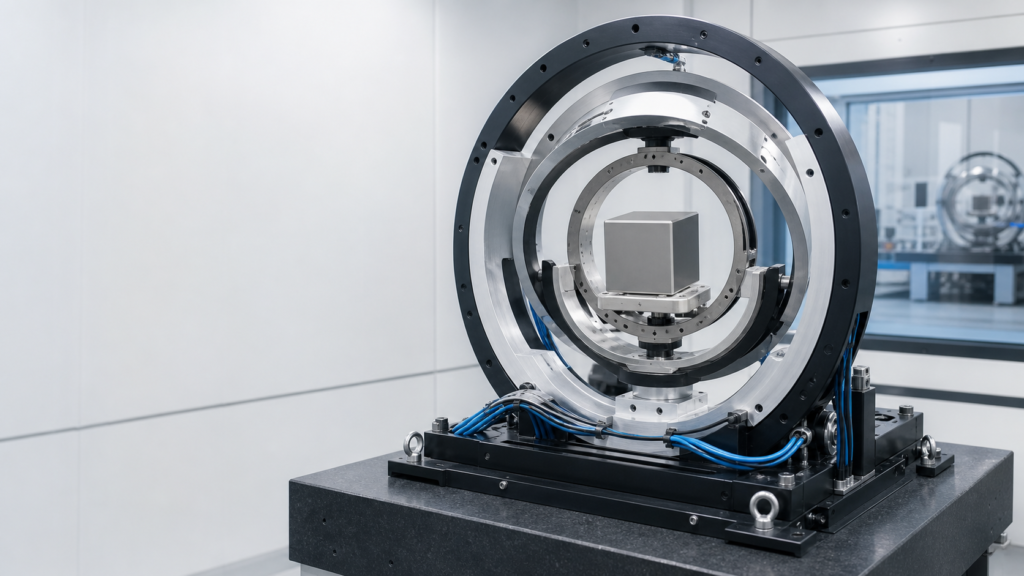
Frameless torque motors can be used in gimballed inertial navigation platforms, rate tables, calibration systems and motion simulators that require precise angular movement.
However, not every inertial navigation system contains a motor.
Modern strapdown inertial navigation systems mount accelerometers and gyroscopes directly to the vehicle and calculate orientation electronically. Gimballed systems use rotating mechanical axes to maintain or control the orientation of an inertial platform.
Frameless motors are most relevant to these gimballed and test-platform applications.
Gimballed Inertial Platforms
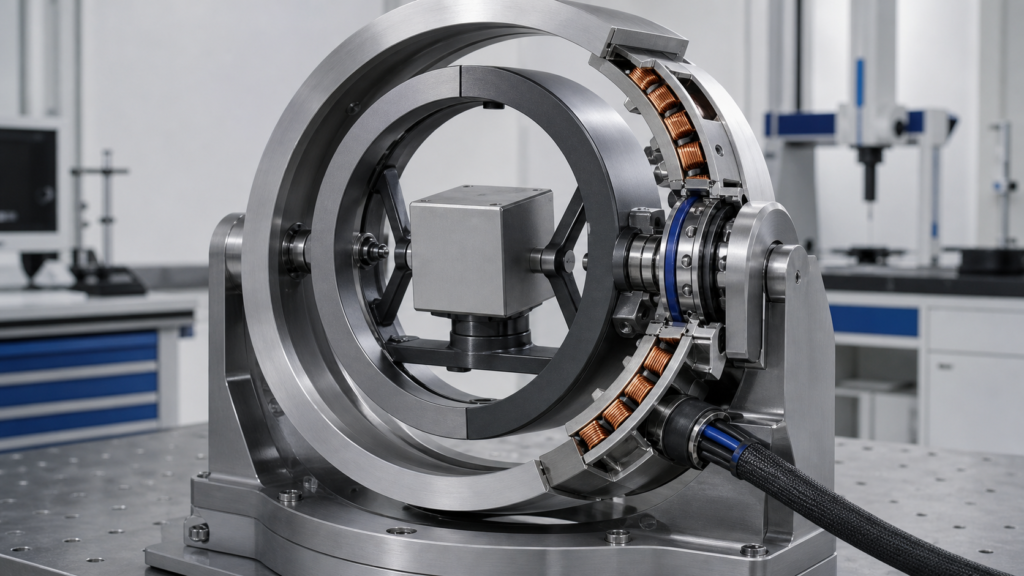
A gimballed inertial platform may use two or three rotary axes to control the orientation of gyroscopes and accelerometers.
Frameless direct-drive motors can be integrated into the gimbal rings to provide:
- Smooth low-speed movement
- Minimal transmission backlash
- Fast disturbance correction
- Compact axis construction
- Flexible encoder installation
- Hollow-axis cable routing
System accuracy still depends on the inertial sensors, bearings, encoders, structural alignment, calibration and control algorithms.
IMU Calibration and Rate Tables
Rate tables rotate an inertial measurement unit through known angles and angular velocities so that engineers can measure sensor bias, scale factor, alignment and response.
Frameless motors may drive:
- Single-axis rate tables
- Multi-axis positioning tables
- IMU calibration systems
- Gyroscope test platforms
- Motion simulators
- Navigation-instrument test equipment
These systems may require both extremely smooth low-speed movement and accurately controlled higher-speed rotation.
Why Is Low Cogging Important?
Cogging torque can create small periodic disturbances as the rotor moves past the stator teeth.
In precision navigation and calibration equipment, these disturbances may affect velocity stability or settling time. Motor geometry, magnet arrangement, winding design, commutation and controller tuning can therefore be optimized for smoother torque production.
A slotless design may be considered when very low cogging is a primary requirement, although it introduces other torque-density and thermal trade-offs.
Selecting a Motor for Navigation Equipment
Engineers should define:
- Axis diameter and axial space
- Payload inertia
- Continuous and peak torque
- Angular-speed range
- Acceleration requirement
- Speed stability
- Positioning resolution
- Permitted cogging torque
- Encoder or resolver type
- Cable-routing requirements
- Temperature and vibration conditions
Motor Dr Navigation Motor Solutions
Motor Dr develops compact, hollow-bore and low-cogging frameless motors for precision rotary mechanisms.
Customization can include winding, voltage, motor geometry, rotor inertia, sensor interfaces, lead wires, temperature monitoring and mounting features.
Frequently Asked Questions
Does every INS require a torque motor?
No. Strapdown INS units generally have no motorized gimbal. Torque motors are more relevant to gimballed platforms and calibration equipment.
Can a frameless motor provide absolute angular position?
The motor produces torque. Absolute position requires an appropriate encoder, resolver or other feedback device.
Can Motor Dr design a low-cogging motor?
Yes. Low-cogging electromagnetic designs can be evaluated according to torque, size and thermal requirements.
Send Motor Dr your axis dimensions, payload inertia, speed-stability target and feedback requirements for a navigation motor evaluation.