Frameless Torque Motors for Battery Electrode Manufacturing
Battery electrode manufacturing requires thin metal foil and coated material to move through multiple processes with controlled speed, tension and alignment.
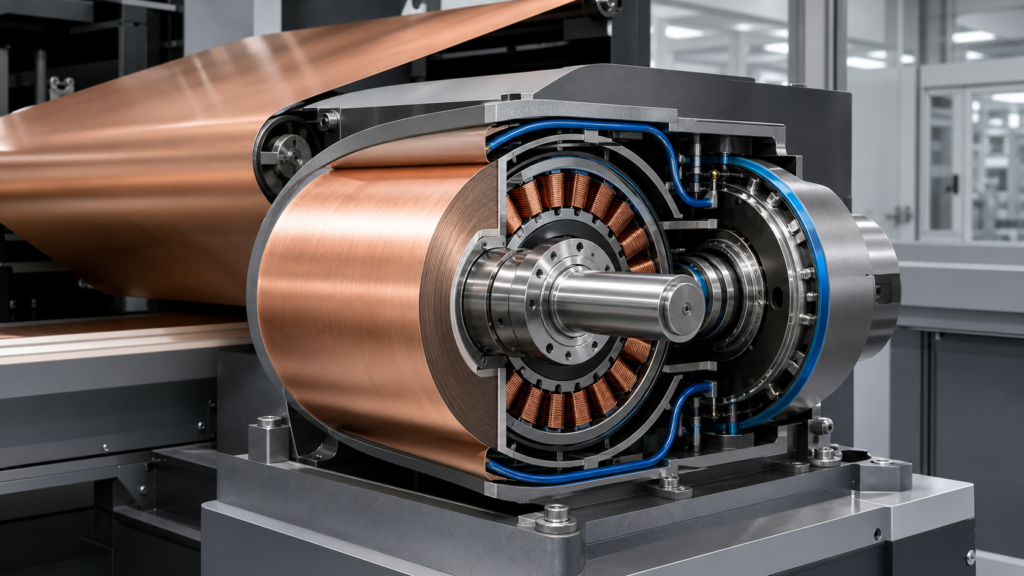
Frameless torque motors can be integrated into rollers and rotary axes used in coating, drying, calendering, slitting, inspection and winding equipment.
Direct drive removes belts and gearboxes from the driven roller, helping reduce backlash, compliance and transmission maintenance.
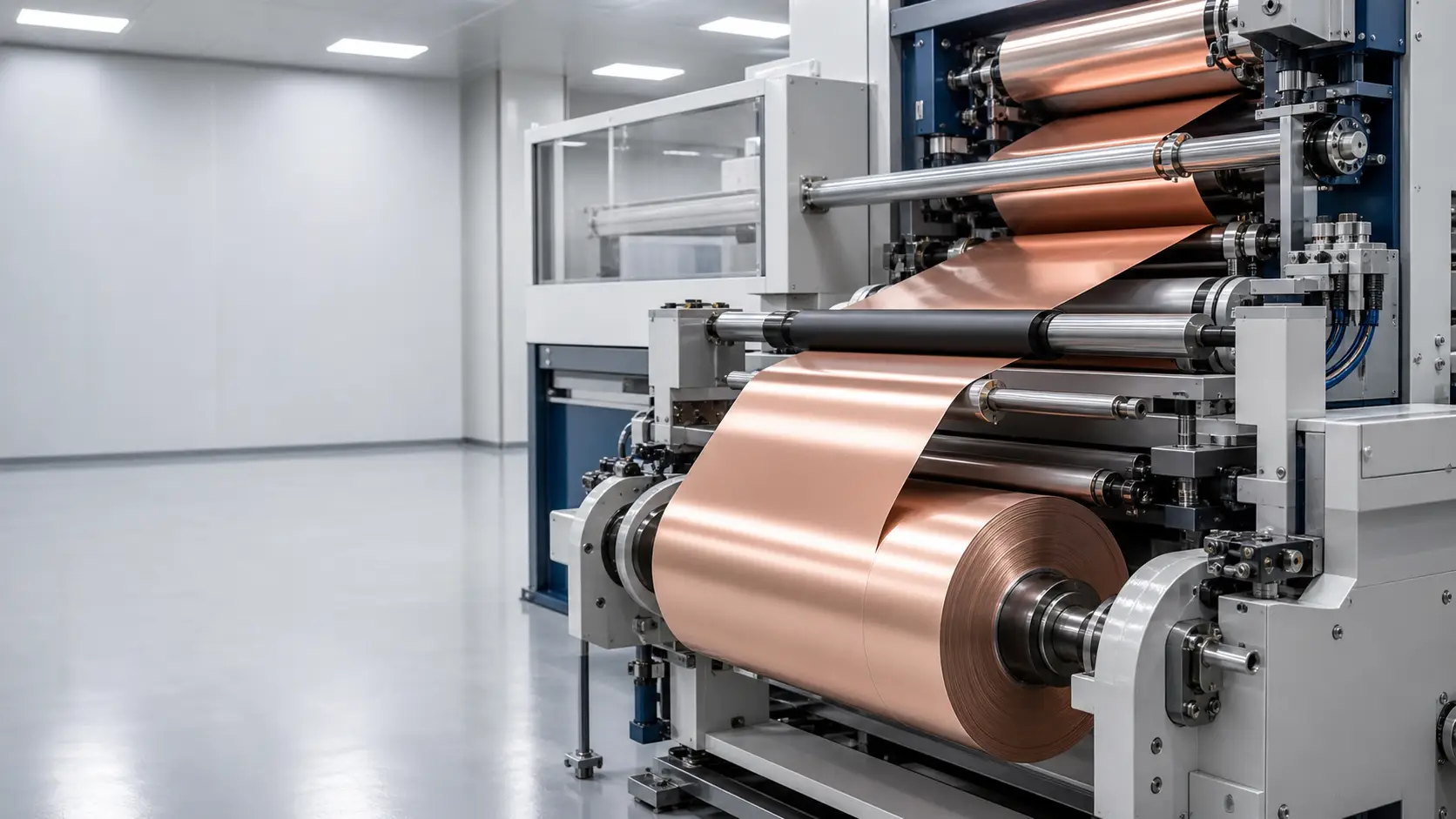
Electrode Coating Equipment
Coating equipment applies active material to copper or aluminum foil.
Accurate roller speed and web tension are important because variations can influence coating thickness, edge quality and downstream processing.
Frameless motors may drive:
- Coating rollers
- Backing rollers
- Unwinding stations
- Rewinding stations
- Tension-control rollers
- Inspection-positioning axes
The motor should be sized around web width, roller diameter, coating speed, tension and continuous thermal load.
Calendering and Roll-Press Equipment
Calendering compresses the coated electrode between rollers to control thickness and material density.
Independent direct-drive rollers can support accurate torque and speed coordination. The motor must also withstand the load reflected through the roller and bearing system.
Important parameters include:
- Roller diameter
- Nip force
- Web speed
- Torque at each roller
- Speed synchronization
- Roller inertia
- Cooling method
- Continuous operation time
The motor does not directly create all pressing force; this is mainly determined by the mechanical roll and loading structure.
Electrode Slitting Equipment
Slitting machines cut wide electrode rolls into narrower strips.
Frameless motors can drive unwinders, rewinders, rotary knives and tension-control axes. Precise coordination helps reduce wrinkles, tracking errors and inconsistent winding.
Fast response may also help the system manage roll-diameter changes during winding and unwinding.
Winding and Web-Tension Control
As material moves from a full roll to an empty roll, the effective roll diameter and inertia continually change.
The control system must adjust motor torque to maintain stable web tension. A direct-drive frameless motor can provide responsive torque without gearbox backlash, but the controller still needs roll-diameter estimation or tension feedback.
Cleanliness and Environmental Requirements
Battery manufacturing equipment may impose requirements related to particles, solvents, dry-room conditions and contamination.
Engineers should specify:
- Cleanliness requirement
- Solvent exposure
- Ambient humidity
- Permitted motor temperature
- Cable and insulation materials
- Enclosure and sealing
- Particle-control requirements
Motor Dr Electrode Equipment Solutions
Motor Dr can develop motors around the roller shaft, machine frame and available cooling structure.
Customization includes:
- Large hollow-bore geometry
- Short axial length
- Custom winding and voltage
- Continuous-torque optimization
- Encoder matching
- Temperature sensors
- Lead-wire and connector options
- Rotor and stator mounting features
Frequently Asked Questions
Can a frameless motor be built into a roller?
Yes. The motor can be designed around the roller shaft and bearing system if the mechanical and thermal interfaces are defined.
Does direct drive automatically maintain web tension?
No. The motor provides controlled torque, while tension sensing and control algorithms regulate the web.
What information should be sent for selection?
Provide roller dimensions, web tension, line speed, load inertia, voltage, duty cycle and environmental requirements.
Send Motor Dr your roller drawing, web speed, tension and operating cycle to evaluate a custom battery-production motor.