Frameless Torque Motors for Aerospace Applications
Frameless torque motors are used in aerospace mechanisms where size, weight, response and integration flexibility are critical.
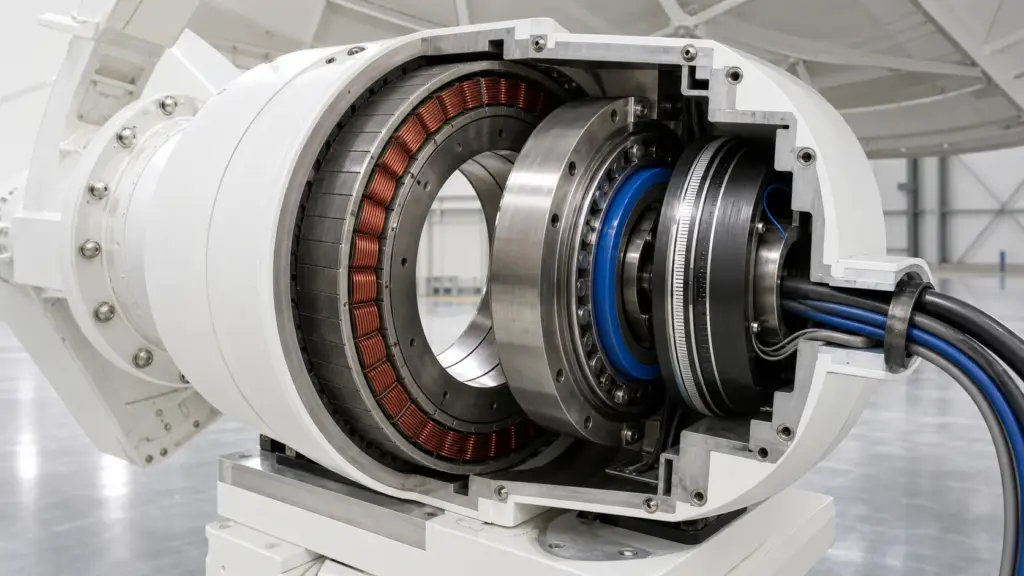
Because the motor rotor and stator are incorporated into the customer’s structure, designers can build the motor around an existing bearing, shaft, optical path or payload.
Direct drive may also eliminate gears and couplings that introduce backlash, compliance and mechanical wear.
UAV and Drone Gimbals
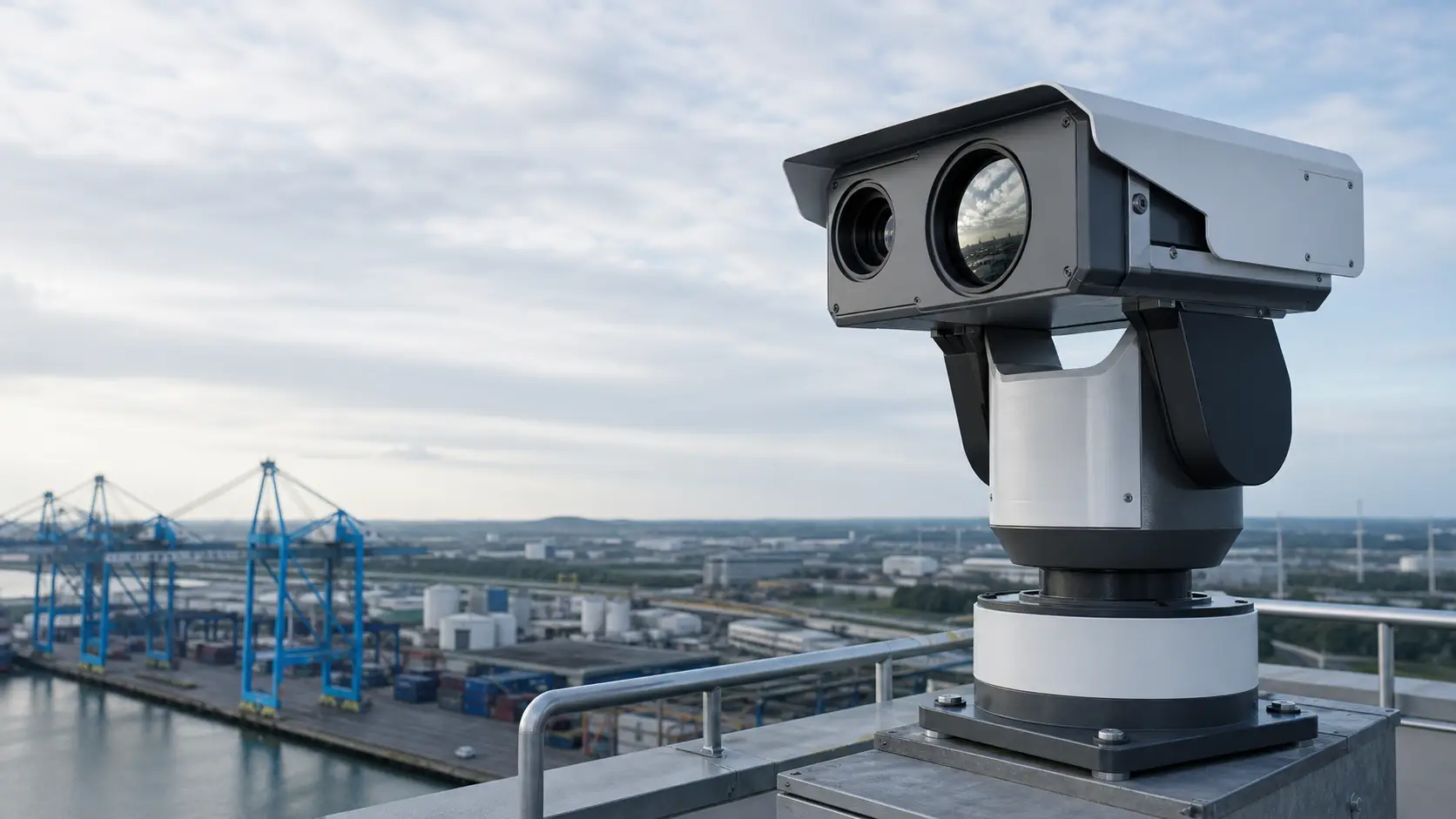
UAV camera and sensor gimbals must compensate for aircraft movement while maintaining a stable line of sight.
Frameless motors can drive the pan, tilt and roll axes of:
- Aerial cameras
- Mapping systems
- Inspection sensors
- Thermal-imaging equipment
- Multispectral imaging systems
- Communication payloads
Important design factors include payload inertia, stabilization bandwidth, disturbance torque, motor weight, cogging torque and available battery power.
Flight-Control and Actuation Mechanisms
Frameless motors may be used in specialized rotary actuators, control-surface test equipment and electromechanical positioning mechanisms.
These systems may require:
- Fast torque response
- High peak torque
- Low rotor inertia
- Compact installation
- Temperature resistance
- Vibration resistance
- Redundant feedback
Environmental and functional qualification must be performed on the completed actuator.
Satellite and Spacecraft Mechanisms
Potential space-related applications include:
- Solar-array positioning
- Antenna pointing
- Instrument rotation
- Optical payload positioning
- Reaction or momentum-control mechanisms
- Ground-based satellite tracking equipment
A standard motor should not automatically be described as space-qualified.
Vacuum applications require specific review of winding insulation, adhesives, outgassing, lubrication, rotor retention, radiation exposure and heat dissipation without normal air convection.
Antenna and Communication Positioning
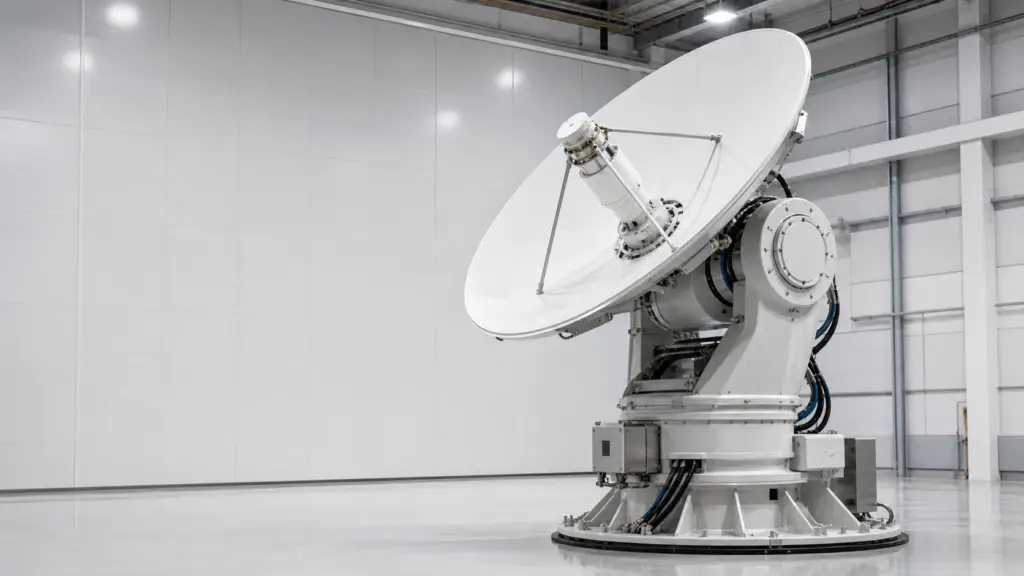
Aircraft, maritime and ground communication systems use rotary axes to point antennas and communication payloads.
A large hollow-center motor can provide a passage for cables, waveguides, optical paths or mechanical structures. Direct drive can also support smooth tracking at low speed and rapid movement between target positions.
Aerospace Testing Equipment
Frameless motors may be used in rate tables, motion simulators, vibration-related test systems and component-positioning equipment.
These ground-based systems often require repeatable motion profiles and accurate synchronization with measurement equipment.
Motor Dr Aerospace Motor Development
Motor Dr can customize:
- Stator and rotor diameter
- Hollow-bore dimensions
- Axial length
- Motor weight
- Continuous and peak torque
- Winding and operating voltage
- Low-cogging characteristics
- Encoder or resolver interface
- Temperature sensing
- Mechanical retention features
Prototype evaluation is especially important before a motor is approved for demanding aerospace environments.
Frequently Asked Questions
Are all frameless motors suitable for vacuum operation?
No. Vacuum operation requires dedicated material, insulation, lubrication and thermal evaluation.
Why are frameless motors used in gimbals?
They can fit directly around the gimbal axis and remove gearbox backlash while providing responsive torque control.
Can Motor Dr provide an aerospace-certified actuator?
Motor Dr supplies motor components and custom motor solutions. Final certification and system qualification remain the responsibility of the equipment manufacturer.
Send Motor Dr your aerospace mechanism dimensions, payload inertia, torque, speed and environmental requirements for engineering review.