Frameless Motors for Semiconductor Equipment
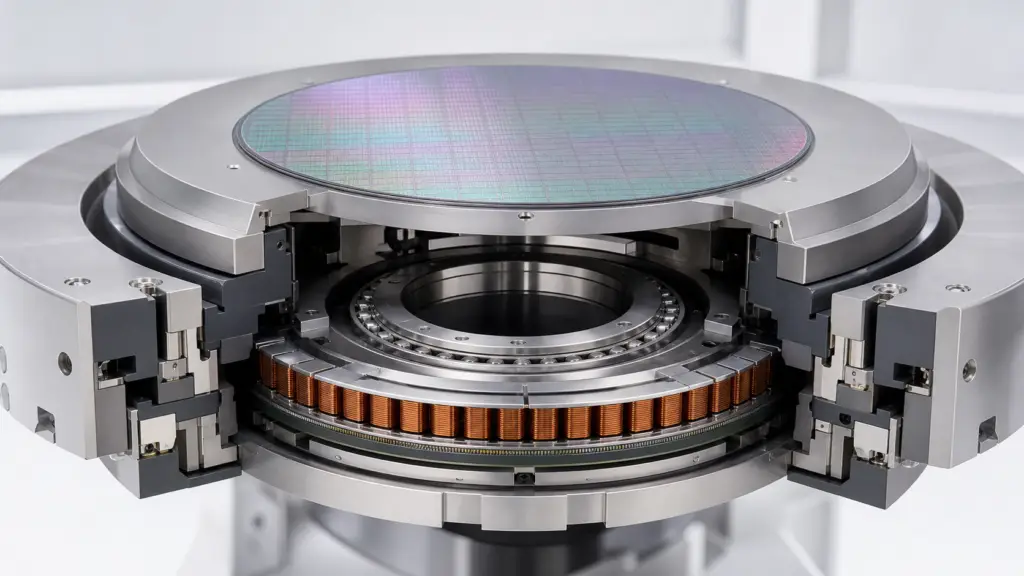
Frameless motors are used in semiconductor equipment when a rotary axis requires precise positioning, smooth motion, compact integration and minimal mechanical transmission.
By mounting the rotor and stator directly into the equipment structure, engineers can design the motor around the wafer stage, spindle, inspection axis or handling mechanism.
In a direct-drive configuration, removing gears and belts eliminates transmission backlash and reduces the number of wear components. Total system accuracy, however, still depends on the encoder, bearings, structural stiffness, vibration control and servo tuning.
Wafer Processing Equipment
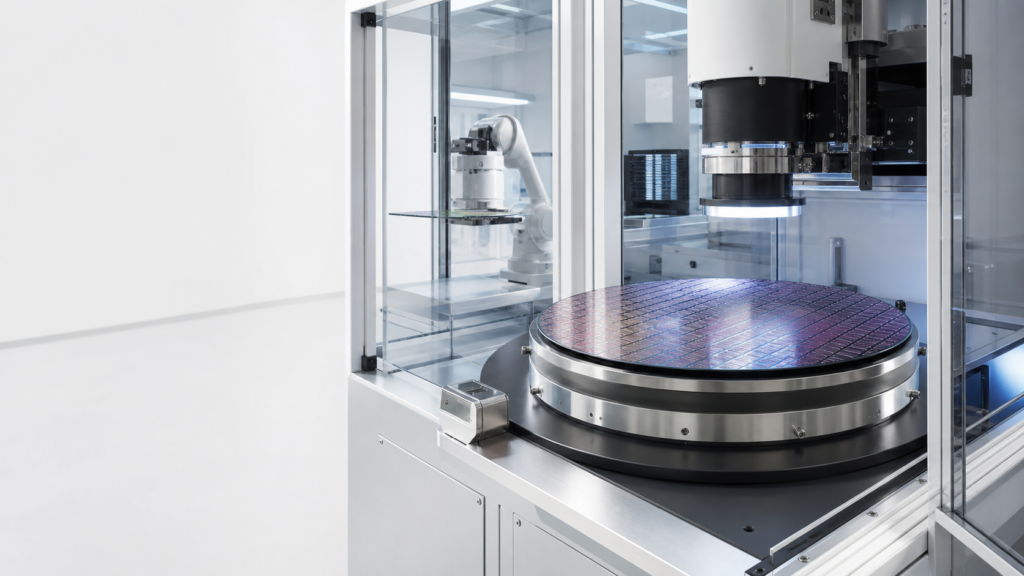
Wafer-processing tools rely on controlled rotation and positioning during coating, cleaning, etching, deposition and other manufacturing steps.
Frameless motors can be applied to:
- Wafer rotation mechanisms
- Spin-processing equipment
- Load-lock mechanisms
- Chamber-handling axes
- Substrate-positioning systems
- Process-module rotary axes
Motor selection should consider speed stability, torque ripple, vibration, particle control and the thermal influence on nearby processes.
Inspection and Metrology Systems
Inspection and metrology equipment must move wafers, optics, cameras and probes with high repeatability.
A frameless direct-drive motor can provide a mechanically simple rotary axis without gearbox backlash. A large central opening may also be useful for routing optical paths, cables, vacuum lines or other system components.
Important system factors include:
- Encoder resolution
- Bearing runout
- Structural stiffness
- Torque ripple
- Thermal drift
- Cable forces
- Control-loop bandwidth
- Settling time
The motor alone does not determine measurement accuracy, but it can remove one important source of mechanical uncertainty.
Lithography and Precision Positioning
Lithography and other high-precision processes require carefully coordinated motion.
Frameless motors may be used in supporting rotary axes, wafer-handling mechanisms, alignment systems or optical positioning assemblies. The motor geometry can be adapted around the equipment’s limited space and hollow-axis requirements.
For precision applications, electromagnetic optimization may focus on smooth torque, low cogging, low heat generation and predictable thermal behavior.
Ion Implantation and Beam-Control Equipment
Ion implantation systems contain mechanisms for wafer positioning, beam alignment and process handling.
Frameless motors can support compact rotary positioning where accurate movement and repeatability are required. Motor materials, cabling and insulation must be reviewed according to the operating environment.
Vacuum exposure, radiation, contamination and temperature requirements must be specified rather than assumed.
Vacuum-System Applications
A standard frameless motor is not automatically vacuum compatible.
For vacuum-related equipment, engineers need to evaluate:
- Outgassing of insulation and adhesives
- Lubrication in the bearing system
- Heat transfer without normal air convection
- Cable and connector materials
- Particle generation
- Rotor retention method
- Temperature sensing
- Required vacuum level
Motor Dr can review application-specific material and winding requirements, but the completed assembly must be tested and qualified by the equipment manufacturer.
Key Parameters for Semiconductor Motor Selection
Provide:
- Required continuous and peak torque
- Speed range and speed stability
- Positioning and repeatability target
- Available outer and inner diameter
- Maximum axial length
- Encoder interface
- Permitted torque ripple
- Thermal limits
- Cooling method
- Cleanroom or vacuum conditions
- Materials restrictions
- Expected duty cycle
Providing the complete motion profile produces a more reliable motor design than selecting only by rated torque.
Motor Dr Semiconductor Motion Solutions
Motor Dr provides standard and custom frameless motors for semiconductor manufacturing and inspection equipment.
Custom options include:
- Large hollow-bore motors
- Low-profile motor geometries
- Custom stator and rotor diameters
- Application-specific windings
- Low-cogging designs
- Temperature sensors
- Encoder matching
- Special lead wires and interfaces
- Prototype and production development
Frequently Asked Questions
Does a frameless motor provide zero backlash?
The motor itself has no gearbox backlash. Total axis behavior still depends on bearings, couplings, structure and feedback placement.
Can a frameless motor operate in a vacuum?
It may be possible with the correct materials and thermal design, but a standard motor should not be assumed to be vacuum compatible.
Can Motor Dr design around a large central aperture?
Yes. Outer diameter, inner diameter and stack length can be evaluated around the required optical, cable or mechanical passage.
Send us your motion profile, dimensional envelope and environmental requirements for a semiconductor motor evaluation.