Direct-Drive Frameless Torque Motors for Machine Tools
Frameless torque motors are used in machine tools to drive rotary tables, spindle mechanisms, indexing axes and precision positioning systems.
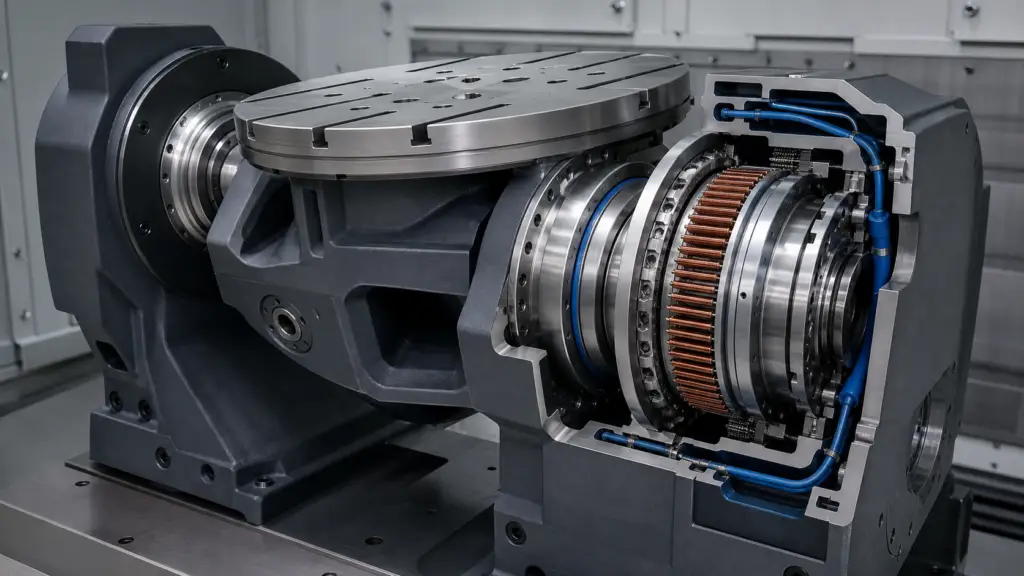
Because the motor is integrated directly into the machine structure, it can transmit torque without a conventional motor housing or separate belt-and-gear transmission.
This can reduce backlash, increase rotary-axis stiffness and simplify maintenance. The result depends on the complete axis design, including bearings, encoder, cooling, structure and control tuning.
Rotary Tables and Indexing Axes
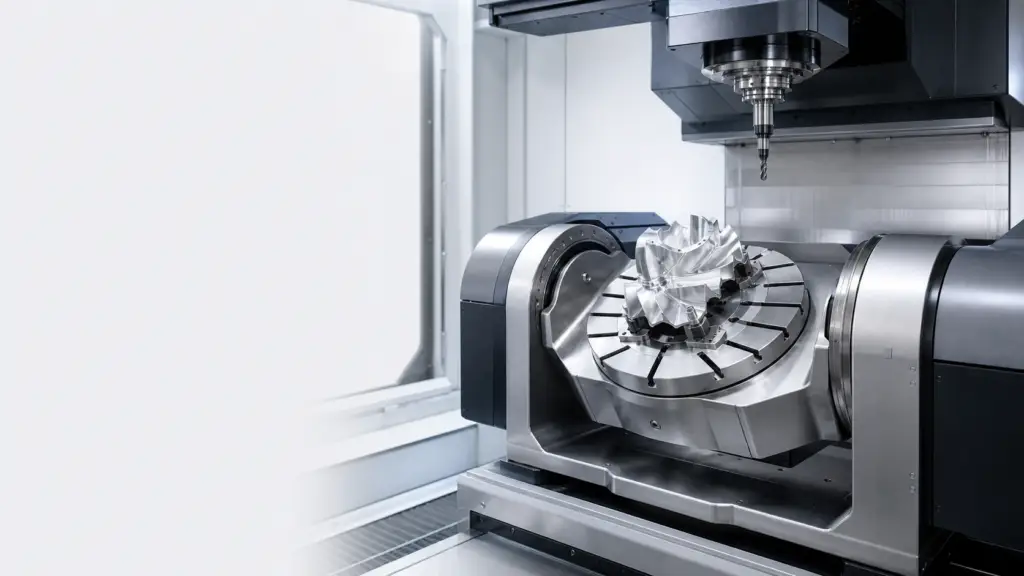
Rotary tables must accelerate a workpiece, hold position against cutting forces and repeatedly return to programmed angles.
Direct-drive frameless motors can be built around the rotary-table bearing and encoder. This architecture eliminates gearbox backlash and can improve response during contouring and indexing.
Key design factors include:
- Table diameter
- Workpiece inertia
- Continuous holding torque
- Peak acceleration torque
- Maximum speed
- Cutting disturbance torque
- Encoder accuracy
- Cooling capacity
A high-load rotary table may require a large-diameter, short-length torque motor to generate the required torque efficiently.
Precision Spindle Applications
Some spindle systems use frameless motors integrated directly around the spindle shaft.
This design can reduce transmission components and create a compact mechanical package. The winding, rotor design and cooling system must be matched to the required speed and power.
Spindle applications require careful evaluation of:
- Maximum rotational speed
- Continuous power
- Rotor retention
- Balance quality
- Bearing system
- Cooling
- Vibration
- Tool-load conditions
A low-speed torque motor and a high-speed spindle motor are not interchangeable; each requires a different electromagnetic and mechanical design.
Robotic Milling and Grinding
Robotic machining systems combine multi-axis robot motion with cutting, grinding or polishing processes.
Frameless motors can be used in robot joints, positioning fixtures, rotary worktables or integrated machining heads. Their compact geometry allows the motor to be built around the axis rather than attached as a separate drive.
Applications include:
- Robotic grinding
- Polishing systems
- Deburring equipment
- Mold finishing
- Compact milling cells
- Rotary workpiece positioners
Coordinate Measuring Machines
Coordinate measuring machines require smooth, repeatable positioning with minimal mechanical disturbance.
Frameless motors may drive rotary tables, articulating probe mechanisms or other rotary positioning axes. Eliminating a gearbox removes one potential source of backlash, but measurement accuracy still depends on calibration, bearings, encoder quality and thermal stability.
Low cogging torque and low heat generation may be important where slow, smooth movement is required.
Electrical Discharge Machining
EDM equipment uses controlled positioning to maintain the relationship between the electrode and workpiece.
Frameless motors can support rotary indexing, electrode positioning and compact automation mechanisms. They may also be used in tool changers or workpiece-handling systems.
Motor selection should be based on axis load, movement speed, positioning requirement, duty cycle and exposure to fluids or contaminants.
Why Customize a Machine-Tool Motor?
Machine-tool builders often have fixed mechanical dimensions that do not match a standard catalog motor.
Motor Dr can adjust:
- Outer diameter
- Hollow-shaft diameter
- Axial stack length
- Continuous and peak torque
- Speed and voltage
- Winding characteristics
- Lead wires and connectors
- Temperature sensing
- Rotor mounting
- Encoder compatibility
- Cooling interface
This helps engineers fit the motor into an existing bearing, shaft, table or spindle architecture.
Information Required for Selection
Please provide:
- Axis type
- Available installation dimensions
- Continuous and peak torque
- Maximum speed
- Load and inertia
- Acceleration time
- Holding-torque requirement
- Positioning accuracy
- Duty cycle
- Cooling method
- Operating voltage
- Environmental exposure
- Encoder specification
For machining axes, cutting forces and disturbance torque should also be included.
Motor Dr Solutions for Machine Tools
Motor Dr develops standard and customized frameless motor kits for precision rotary motion.
Solutions may include:
- High-torque frameless motor kits
- Large hollow-bore motors
- Low-profile motors
- High-speed custom windings
- Encoders and feedback matching
- Temperature sensors
- Integrated rotary modules
- Prototype and production support
Frequently Asked Questions
Can a frameless motor improve machine accuracy?
It can remove gearbox backlash from a direct-drive rotary axis, but overall accuracy still depends on the full mechanical and control system.
Are frameless torque motors suitable for high-speed spindles?
Some frameless motors can be designed for spindle use, but high-speed operation requires a dedicated rotor, winding, balance, bearing and cooling design.
Can Motor Dr match an existing rotary-table structure?
Yes. We can evaluate the existing diameter, hollow bore, axial space, torque, speed, encoder and cooling arrangement.
Share your machine structure, load data and motion requirements to develop a motor around your rotary axis.