Frameless Motors for Electro-Optical Turntables
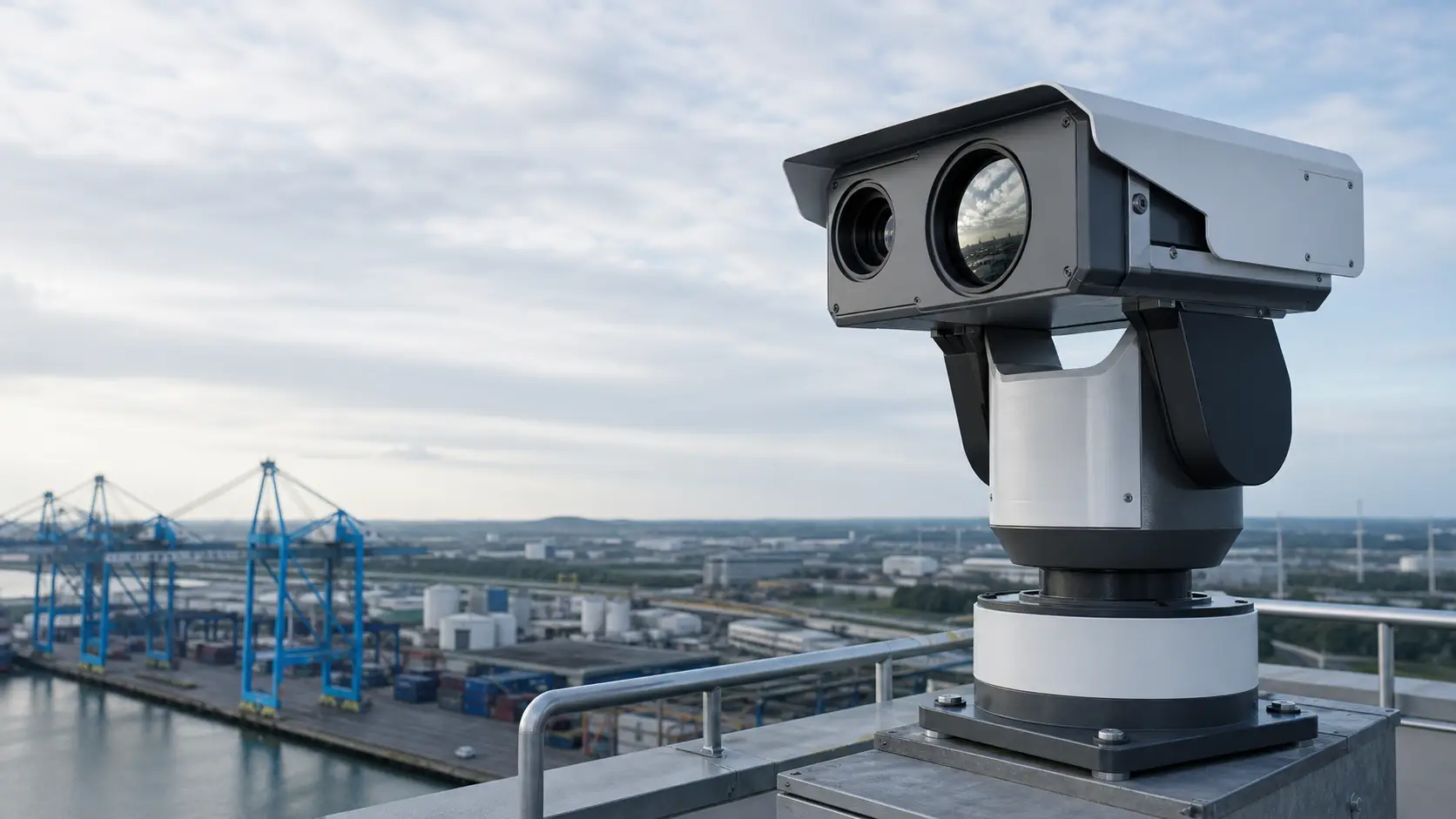
Electro-optical turntables and gimbals use rotary axes to position cameras, thermal imagers, lasers and other sensors.
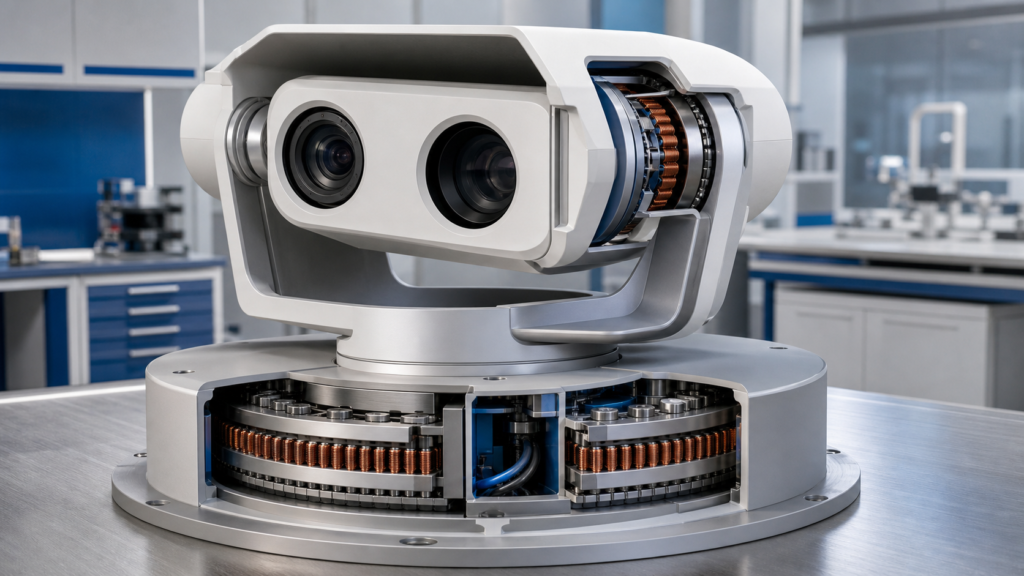
Frameless torque motors are well suited to these mechanisms because they can be integrated directly around the azimuth or elevation axis.
A direct-drive structure eliminates gearbox backlash and allows the motor to apply torque directly to the sensor platform.
What Is an Electro-Optical Turntable?
An electro-optical turntable is a controlled rotary platform that changes the viewing direction of one or more optical sensors.
Depending on the application, the payload may include:
- Visible-light cameras
- Thermal cameras
- Infrared sensors
- Laser rangefinders
- Industrial inspection sensors
- Mapping equipment
- Communication or tracking instruments
The platform may use one, two or more axes for pan, tilt and roll movement.
Pan-and-Tilt Camera Systems
Frameless motors can be built around the pan and tilt bearings to create a compact axis.
Potential advantages include:
- Smooth low-speed tracking
- Rapid repositioning
- Minimal mechanical backlash
- Low transmission noise
- Flexible hollow-axis routing
- Reduced gearbox maintenance
The hollow center can provide space for cables, slip rings, optical paths or structural components.
Stabilized Sensor Gimbals
Vehicle, aircraft, maritime and mobile sensor platforms must compensate for vibration and platform movement.
The motor must respond quickly to commands from gyroscopes and the stabilization controller. Motor torque, rotor inertia and control bandwidth must be matched to the payload rather than selected independently.
A motor with excessive cogging or torque ripple may create unwanted image movement at low tracking speeds.
Industrial Inspection and Measurement
Electro-optical turntables are also used in civilian applications such as:
- Long-range industrial inspection
- Infrastructure monitoring
- Port and maritime observation
- Environmental monitoring
- Broadcast camera systems
- Telescope positioning
- Robotic vision platforms
These applications may prioritize smooth scanning, repeatable positioning and long-duration operation.
Selecting a Gimbal or Turntable Motor
Provide:
- Payload mass and inertia
- Axis arrangement
- Continuous holding torque
- Peak disturbance torque
- Slewing speed
- Acceleration
- Pointing and repeatability requirements
- Available diameter and axial length
- Hollow-bore requirement
- Encoder type
- Supply voltage
- Operating temperature
- Vibration conditions
The required torque should be calculated from payload inertia, acceleration, imbalance, friction, cable forces and external disturbances.
Motor Dr Electro-Optical Motor Solutions
Motor Dr develops compact and customized frameless motors for electro-optical gimbals, camera platforms and rotary sensor systems.
Options include:
- Large hollow-center motors
- Thin axial profiles
- Low-cogging configurations
- Lightweight rotor designs
- Custom windings
- Encoder or resolver matching
- Hall and temperature sensors
- Custom mounting interfaces
- Prototype motor development
Frequently Asked Questions
Why use direct drive instead of a gearbox?
Direct drive removes gearbox backlash and compliance, which can improve smoothness and dynamic response. It may require a larger-diameter motor to produce sufficient torque.
Can cables pass through the motor center?
Yes. The rotor bore can be designed around cables, slip rings, shafts or optical components.
Does the motor alone determine pointing accuracy?
No. Pointing performance also depends on the encoder, bearings, structure, balancing, sensors and control system.
Send Motor Dr your payload inertia, axis dimensions, speed and stabilization requirements to discuss a custom gimbal motor.