

Frameless Torque Motors for Robotics
Frameless torque motors are well suited for robotic joints because the rotor and stator can be integrated directly into the robot’s mechanical structure. This gives engineers greater control over joint diameter, axial length, hollow-shaft size, torque output, sensing and thermal design.
Unlike a conventional housed motor, a frameless motor does not include a standard housing, shaft or bearing system. The machine designer can use the robot’s own bearings, shaft and enclosure, creating a more compact actuator around the actual application.
Depending on the joint architecture, frameless motors can be used in direct-drive, low-reduction or geared robotic joints.
Why Are Frameless Motors Used in Robot Joints?
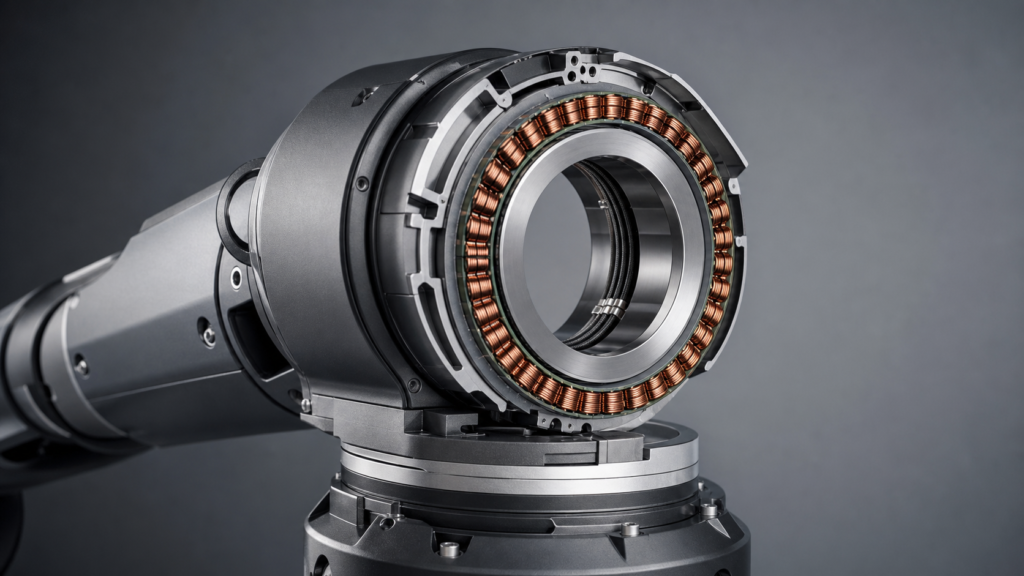
A robot joint must deliver more than rotation. It may need to produce high torque at low speed, respond quickly to control commands, fit inside a narrow mechanical envelope and maintain smooth motion through repeated cycles.
Frameless motors can help meet these requirements by providing:
- High torque density within a compact joint
- Flexible outer diameter, inner diameter and stack length
- A large hollow center for cables, brakes or sensors
- Smooth torque control at low speed
- Reduced mechanical backlash in direct-drive configurations
- Lower transmission complexity
- Integration with encoders, brakes and joint electronics
Eliminating or reducing transmission components may also reduce mechanical wear, noise and maintenance. However, final performance depends on bearing design, air-gap control, encoder resolution, drive tuning, cooling and the complete joint structure.
Collaborative Robots
Collaborative robots operate close to people, so smooth movement and controlled joint torque are essential.
Frameless torque motors can be integrated with a high-resolution encoder and torque-control system to support responsive movement, controlled acceleration and repeatable positioning. Their compact structure also helps engineers reduce joint size without forcing every axis to use an oversized standard motor.
Typical applications include:
- Cobot shoulder, elbow and wrist joints
- Compact rotary actuators
- Electric grippers
- Force-controlled assembly systems
- Teaching and positioning mechanisms
Humanoid Robots
Humanoid robots require multiple joints with very different mechanical requirements. A hip joint may need high peak torque, while a wrist or finger joint may prioritize low weight and compact dimensions.
A customized frameless motor allows engineers to adjust the motor geometry and winding around each joint instead of selecting one catalog motor for the entire robot.
Motor Dr can develop different motor configurations for:
- Hip, knee and ankle joints
- Shoulder and elbow joints
- Wrist rotation
- Dexterous hands
- Neck and waist mechanisms
For highly integrated joints, the motor can also be designed around an existing reducer, encoder, brake, hollow shaft or joint housing.
Mobile Robots and Robotic Platforms
Mobile robots use motors in wheels, steering modules, lifting mechanisms, sensor platforms and robotic arms.
Frameless motors are especially useful when the motor must fit inside a wheel hub, rotary module or compact actuator. Their hollow-center structure can provide space for wiring or other mechanical components.
Applications include:
- Autonomous mobile robots
- Warehouse robots
- Inspection robots
- Quadruped robots
- Robot wheel modules
- LiDAR and camera positioning units
Exoskeletons and Wearable Robots
An exoskeleton motor must produce useful assistance without making the device unnecessarily heavy or bulky.
Frameless motors can be integrated into thin joint structures around the hip, knee, ankle, shoulder or elbow. The motor dimensions, winding, voltage and torque characteristics can be adjusted according to the user load, movement range and available cooling.
Noise, cogging torque, weight and thermal comfort should all be considered during development.
What Should Engineers Specify?
When selecting a frameless motor for a robotic joint, provide:
- Available outer diameter
- Required inner or hollow-shaft diameter
- Maximum axial length
- Continuous and peak torque
- Maximum and operating speed
- DC bus voltage
- Duty cycle and motion profile
- Cooling method
- Ambient temperature
- Encoder type and resolution
- Reducer ratio, if used
- Target weight and production volume
These parameters allow the motor to be evaluated as part of the complete actuator rather than as an isolated component.
Custom Robot Joint Motors from Motor Dr
Motor Dr develops standard and customized frameless motors for robotic applications. Customization can include motor diameter, hollow bore, stack length, winding, voltage, speed, torque, lead wires, temperature sensors and mechanical interfaces.
We can also support integrated solutions involving:
- Frameless motor stator and rotor sets
- Encoders and position feedback
- Robot joint modules
- Motor and reducer matching
- Prototype development
- Small-batch and production-stage manufacturing
If a catalog motor is close but does not match your joint, send us the available dimensions, torque, speed, voltage and operating conditions. Our engineers can evaluate whether an existing platform can be modified or a new motor should be developed.
Frequently Asked Questions
Are frameless motors always direct drive?
No. A frameless motor can be used in a direct-drive joint, but it can also work with a harmonic, planetary or cycloidal reducer.
Can the center of the motor be used for cable routing?
Yes. The rotor bore can be designed to accommodate cables, shafts, brakes, sensors or other joint components.
Can Motor Dr customize a motor around an existing robot joint?
Yes. We can evaluate the available installation envelope, torque-speed requirement, voltage, cooling and mechanical interface to develop a matching motor.
Developing a robot joint? Send us your dimensions, torque, speed and voltage requirements to discuss a custom motor solution.